
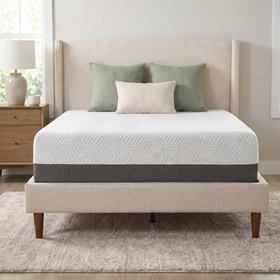

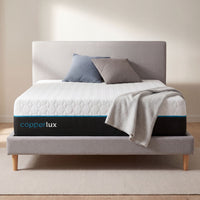

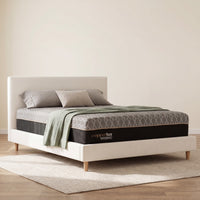
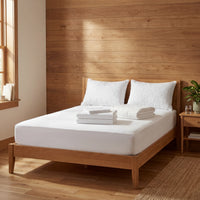





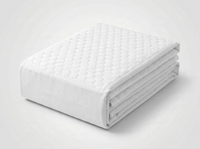
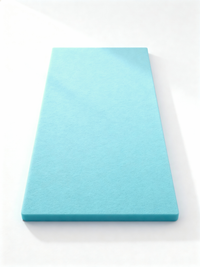

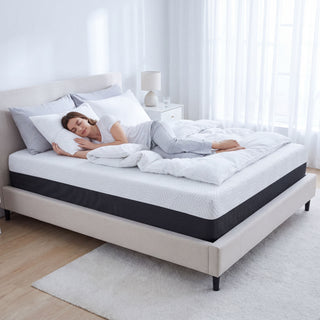

Mattress pricing is designed to confuse you. The same size and type can be $400 at a warehouse club and $4,000 at a luxury showroom, and the salesperson at each will tell you their number is the "right" one. So how much should a good mattress actually cost? Here's a straight answer: what drives the price, a fair range for a quality bed in 2026, and why the same mattress can cost four times as much depending on where you buy it.
What actually drives a mattress's price
Three things determine what a mattress costs to build. Everything else is markup.
- Materials and build. A basic foam mattress costs less to make than a hybrid with individually pocketed coils and quality comfort layers. This is real and worth paying for — better materials last longer and support better.
- Type. All-foam is generally cheapest to build, hybrids cost more (coils + foam), latex and specialty builds cost most.
- Size. Twin up to California King — bigger uses more material and costs more. Simple.
That's the legitimate cost. The problem is that at retail, the price you pay is mostly not those three things.

A fair price range in 2026 (directional)
Here's roughly what a genuinely good mattress should cost when you're not paying for a showroom — quality materials, built to last 8–10 years, no luxury-brand tax:
| Type (Queen) | Fair factory-direct range |
|---|---|
| Quality all-foam (Queen) | $400–$700 |
| Quality hybrid, pocketed coils (Queen) | $600–$900 |
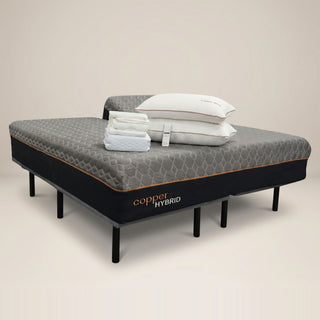
| Premium cooling/copper hybrid (Queen) | $850–$1,050 |
(Swap in live numbers.) Below the bottom of these ranges, you're usually getting thin materials that sag in a couple of years. Far above the top, you're not getting a better bed — you're getting a markup. Here's why that markup exists.
Why the same mattress costs 4x more at a showroom
A mattress at a luxury store passes through a chain before it reaches you: factory → distributor → brand licensing → retailer. The retailer then has to cover a giant showroom's rent, the floor models hundreds of people lie on, the financing desk, the delivery crew, and a salesperson's commission. By the time it reaches your bedroom, the mattress itself might be a third of the price. The rest is the building and the chain.
That's why a $400 bed and a $4,000 bed can use comparable foam. The expensive one isn't four times the mattress — it's the same mattress wearing the cost of a showroom and a luxury logo.
Factory-direct deletes most of that chain. Same quality build, shipped from a warehouse to your door, priced at roughly what the bed is actually worth. That's the whole reason the "fair" ranges above are well below the showroom numbers.
How to know you're paying a fair price (not overpaying or under-buying)
- Match specs, not labels. Coil count/type, comfort-layer materials, thickness, warranty. Compare those across sellers and the "luxury" markup usually disappears.
- Don't under-buy either. A $300 bed-in-a-box that sags in 18 months isn't a deal — you'll replace it twice in the time a quality mattress lasts once. Cheapest isn't the goal; fair is.
- Weight the warranty and trial. A 10-year warranty and a real home trial are worth money. A rock-bottom price with no trial and a thin warranty isn't actually cheaper.
- Factor cost-per-year. A quality mattress at a fair price that lasts 8–10 years beats a cheap one you replace every 2–3.
What a fair price looks like at Omne
We sell quality mattresses factory-direct out of Phoenix — pocketed-coil hybrids and cooling builds — priced in the fair ranges above instead of the showroom-inflated ones, because there's no showroom in the price. Same class of bed the luxury stores sell, minus the markup, backed by a 90-night trial and 10-year warranty.

See our mattresses
See our mattresses — factory-direct from Phoenix.
See our mattresses — factory-direct from Phoenix →A reasonable price for a quality mattress in 2026 isn't a mystery. It's the cost of a well-built bed — not the cost of the building you bought it in.

